
***
You are at what was once the stopping point of Bluewater. All that’s left today of the Route 66 era are the remains of the old Bluewater Motel, Allen’s Garage, and the Old Crater Trading Post. All silent now, they attest to the better times along this old chunk of the road.
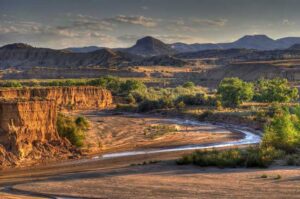
As you headed west out of Albuquerque, New Mexico, on Route 66, a few scenic descents from Nine Mile Hill into the Rio Puerco Valley, you should’ve seen a Parker. The valley is the site of Laguna Pueblo, the home of Puebloans since the 1300s. Because the Rio Puerco (Puerco River) is known for its violent flooding and severe erosion, the State Highway Department specifically chose a Parker truss bridge design for the Rio Puerco Bridge to eliminate the need for a center pier and prevent washouts.
45 miles west of Albuquerque you went through Pueblo of Laguna. The largest of the Keresan pueblos, it is comprised of six small villages including Laguna, Paguate, Encinal, Mesita, Seuma, and Paraje.
Pueblo tradition says that their people have always been there. The Spanish name, Laguna, translates to lagoon and is derived from a lake that was once located on the pueblo lands. The people refer to themselves as Ka-Waikah or Ka-waik, meaning “lake people”, though the lake has long since transitioned into meadowlands.
Just beyond Bluewater, you will see beautiful red sandstone cliffs to the right and the volcanic cone of El Tintero, where lava was said to have flowed as far east as Grants.
A must stop ahead is El Rancho Hotel in Gallup. Built in 1937 by the brother of famous director D.W. Griffith, the hotel was a de facto home for Hollywood elite and film crews when they were shooting films in the area.
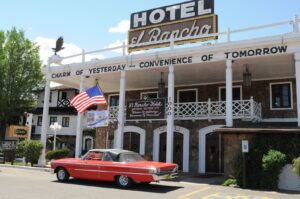
Its rooms have played host to the likes of Ronald Reagan, Katharine Hepburn, and John Wayne, and the hotel captures the look and feel of a Wild West hunting lodge with its cavernous lobby of dark wood and brickwork. Its white outdoor portico, which bears the phrase “Charm of yesterday…convenience of tomorrow,” and the hotel’s vibrant neon sign have made it one of the most historic — and photographed — sights on the route.
You’ll be crossing to Arizona soon after.
***

